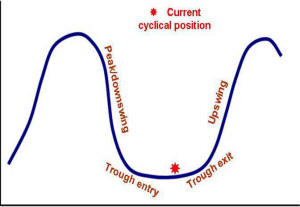
The Current View
Growth in demand for raw materials peaked in late 2010. Since then, supply growth has generally outstripped demand leading to inventory rebuilding or spare production capacity. With the risk of shortages greatly reduced, prices lost their risk premia and have been tending toward marginal production costs to rebalance markets.
The missing ingredient for a move to the next phase of the cycle is an acceleration in global output growth which boosts raw material demand by enough to stabilise metal inventories or utilise excess capacity.
The PortfolioDirect cyclical
guideposts suggest that the best possible macroeconomic circumstances for
the resources sector will involve a sequence of upward revisions to
global growth forecasts, the term structure of metal prices once again
reflecting rising near term shortages, a weakening US dollar, strong money
supply growth rates and positive Chinese growth momentum. None of the five guideposts is "set to green"
(after the most recent adjustments in December 2016) suggesting the sector remains confined
to near the bottom of the cycle.

Has Anything Changed? - Updated View
From mid 2014, the metal market cyclical position was characterised as ‘Trough Entry’ with all but one of the PortfolioDirect cyclical guideposts - the international policy stance - flashing ‘red’ to indicate the absence of support.
Through February 2016, the first signs of cyclical improvement in nearly two years started to emerge. The metal price term structure reflected some moderate tightening in market conditions and the guidepost indicator was upgraded to ‘amber’ pending confirmation of further movement in this direction.
As of early December 2016, the Chinese growth momentum indicator was also upgraded to amber reflecting some slight improvement in the reading from the manufacturing sector purchasing managers index. Offsetting this benefit, to some extent, the policy stance indicator has been downgraded from green to amber. While monetary conditions remain broadly supportive, the momentum of growth in money supply is slackening while further constraints on fiscal, regulatory and trade regimes become evident.
Comfortable But No Improvement
Global economic conditions display a plethora of relatively minor without
threatening a material slowdown in growth.
This relatively comfortable set of circumstances for the resources industry remains insufficient to force a meaningful change in market valuations.
The median change in the prices of the 850 or so ASX-listed resources stocks since mid 2016 has been zero.
The cyclical positioning indicator on this page suggests a marked improvement in metal prices but a loss of momentum.
The key question presently confronting resource sector investors is whether share price gains during 2016 are the launching pad for a more sustained recovery or have merely been an albeit much needed tension breaker after pessimism had simply become unreasonably intense in the late 2015 .
Implicit in the PortfolioDirect description of the cycle as still being in the 'trough entry' phase and the recommended partial allocation of available funds to the sector (i.e. retention of relatively high cash holdings) is that the latter is a more accurate characterisation of global conditions.
Interest Rate Cycle Gathers Pace
The Federal Reserve has prepared the ground for a rise in U.S. interest
rates as the U.S. economy closes in on its inflation and employment goals.
With a Fed Funds rate rise in the upcoming meeting in March a foregone
conclusion, attention will turn to what the Fed says about the future track
of rates and whether current FOMC participants foresee the need for a more
aggressive sequence of rises.
The U.S. economy remains on a sub-2% growth path. The new Trump administration has, at least rhetorically, targeted 4%.
Presumably, achieving the higher rate of growth would imply a far more aggressive rise in interest rates which could add significantly to financial market volatility worldwide and not just in the USA .
Conversely, any delay in or abandonment of anticipated policies affecting taxes or business regulations could disappoint business and cause a slackening in investment spending or a postponement of decisions until the policy framework becomes clearer.
In this scenario, the Fed might find itself backtracking to accommodate a slow moving legislature .
Neither scenario is particularly attractive for the resources sector.
In any event, the best conditions for the sector are usually the product of policy accidents in which growth rises surprisingly quickly rather than the results of careful planning.
For the time being, the outlook suggests little change in the pace of growth in the USA, Europe, Japan or China.
A deviation from this view is more likely to involve a pickup in the pace of growth in the U.S. being offset by some losses in Chinese momentum.
Bond Yield Trends
U.S. bond yields have been a benign influence for decades as they have
tracked lower.

A change in direction has been anticipated often without being realised although, almost by definition, yields in recent years have been closer to the bottom of what is feasible.
Markets are currently grappling with whether yields remain around recent levels indefinitely having priced in lower growth and lower inflation or whether rising short term interest rates and an improvement in growth combine to produce a sentiment swing and the first widespread capital losses in a generation.
Yield movements in the past week have been consistent with an emerging turning point as well as simply trading toward the upper end of a range consistent with a longer term flat trend..